If Lattice, Culture Amp and 15Five are on your shortlist, this page compares them on the job a scale-up buys them for: running a fair review and calibration cycle. It uses only each vendor’s own public pages, with every fact linked and dated. Disclosure: Ash Taherian works at Revolut People, which sells performance management software. Its section near the end follows the same rule: every claim links to its public documentation.
Facts checked: 10 November 2026, on each vendor’s own pricing and product pages. Prices change, so open the linked page before you budget.
Quick answer: which fits which scale-up
There is no overall winner. Each tool leads with a different job, so start from the job you are buying for:
- Reviews and calibration first: Lattice’s Performance product lists reviews, calibration, talent reviews, promotions and PIPs, at a published per-seat price (Lattice pricing).
- Engagement surveys first: Culture Amp leads with its Engage product (pulse surveys, benchmarking, action plans) and sells on quote (Culture Amp pricing).
- Manager cadence first: 15Five’s Perform plan includes weekly check-ins and 1-on-1 agendas alongside reviews, at a published per-user price (15Five pricing).
All three list reviews, goals and calibration in some form. What separates them for a 200 to 2,000 person scale-up is how each runs a calibration meeting on your data, so this page includes a test to take into every vendor call.
How we compared them
The criteria come from the Playbook’s performance management software buyer’s guide: process fit, goals, reviews, calibration, evidence, integrations and pricing transparency. For each tool we used only that vendor’s pricing page and product pages, checked on 10 November 2026, and no review sites or third-party lists. Where a vendor doesn’t say something, the scorecard says “not stated publicly”. That is not the same as “doesn’t have it”, so ask in the call.
Lattice
What it covers
Lattice sells three base products. Performance lists performance reviews, succession planning, promotions, PIPs, talent reviews and calibration. Goals & OKRs lists cascading goals, progress updates, and Salesforce and Jira integrations. Engagement lists pulse surveys, action planning and eNPS. Every base product includes 1:1s, weekly updates and feedback (Lattice pricing). Its reviews page lists annual, quarterly, project-based or automated cycles, calibration workflows and AI-drafted reviews (Lattice performance reviews).
Pricing as published
On 10 November 2026, Lattice’s pricing page listed Performance at $10 per seat per month, Goals & OKRs at $8 and Engagement at $4. Add-ons were Compensation at +$6 and Grow at +$4 per seat per month. The page states: “The minimum annual agreement is $4,000.” It also says Lattice bills all contracts annually, bills in US dollars only, and has no additional costs for change management or implementation for its performance management software (Lattice pricing).
Where it fits a 200–2,000 person company
Lattice suits a People team that wants reviews, calibration and talent decisions (promotions, PIPs, succession) in one product, with goals and engagement as separate modules. If review scores depend on goal results, you may need both Performance and Goals & OKRs, so price both.
Culture Amp
What it covers
Culture Amp sells two main products. Engage lists pulse surveys, retention insights, AI comment summaries, action plans and benchmarking. Perform lists continuous feedback, performance reviews and calibration, 1-on-1s, development plans and goal management. Every plan includes AI Coach, HRIS, Slack and Microsoft Teams integrations, SSO and “Full GDPR & SOC2 compliance” (Culture Amp pricing). Its performance review page describes built-in calibrations and calibration reports to support promotion decisions (Culture Amp performance reviews).
Pricing as published (quote only)
Culture Amp does not publish a list price. Its pricing page says: “Pricing depends on the number of employees, product chosen, and service tier. All Culture Amp products are billed on an annual basis.” Service levels are described by company size: under 200 employees, 200 to 999 (which adds a one-on-one Customer Success partnership and project-managed implementation), and enterprise at 1,000 or more (Culture Amp pricing).
Where it fits
Culture Amp suits a company whose first problem is engagement and listening, and that wants reviews on the same platform. Its size bands split the 200 to 2,000 range at 1,000, so ask which service tier your quote assumes and what changes as you grow.
15Five
What it covers
15Five sells Engage (engagement surveys, eNPS, benchmarking, lifecycle surveys), Perform and a Total Platform that combines both with manager training microlearnings. Its pricing table shows Perform including AI-assisted performance reviews, 360° reviews (manager, peer and upward), calibrations, a 9-box talent matrix, weighted OKRs, competencies, career paths, PIPs and succession planning, 1-on-1 agendas and weekly check-ins. The same table shows engagement surveys in Engage and Total Platform, not in Perform (15Five pricing).
Its calibration page describes real-time rating adjustments, flagging employees for discussion, a drag-and-drop talent matrix, rating distribution across managers, and a “track changes” feed of original versus calibrated scores (15Five calibrations).
Pricing as published
On 10 November 2026, 15Five listed Engage at $4, Perform at $11 and Total Platform at $16 per user per month, billed annually. The page notes “Updated February 2026. Pricing subject to change.” On minimum spend, it says standard packages are flexible and some optional add-ons may include minimum requirements (15Five pricing).
Where it fits
15Five suits a company that wants managers in a weekly rhythm of check-ins and 1-on-1s, with reviews and calibration on top. If you also want engagement surveys, price Total Platform rather than Perform.
Side-by-side scorecard
Every cell links to the vendor page it came from, checked 10 November 2026. Reuse it: add your own scores after each vendor call.
Download the dated scorecard (PDF) Same facts, with space for your scores.
The calibration demo test most comparisons skip
A ratings grid on a demo account proves little. Calibration is where leaders check that one manager’s “exceeding” means the same as another’s. The Playbook’s guide to running a calibration meeting uses three checks: generous graders, thin evidence, and outliers. Ask every vendor to run these live, ideally on anonymised data from one of your teams, and score each answer from 0 to 2.
- Generous graders. “Show me how the tool tells me one manager rates far more people at the top than their peers.” Look for a distribution by manager.
- Thin evidence. “Show me a grade that isn’t backed by goal results or written examples, and how the tool surfaces it.” Look for evidence beside the grade.
- Outliers and jumps. “Show me someone whose grade jumped since last cycle.” Look for past grades in view.
- Who signs off. “Who can change a grade, at what stage, and where is the reason recorded?” Look for original versus calibrated grades and the reason for each change.
- How grades are published. “Can grades go to managers before employees, and what does the employee see?”
- Your scale, not theirs. “Set this up with our grade names and our levels.” If the demo only works on the vendor’s default scale, note that.
Twelve points is the maximum. Score what you saw, not what you were told: a feature that can’t be shown scores 0.
UK and Ireland notes
Most comparisons are written for US buyers. For a UK or Irish scale-up, three things change:
- Currency. Lattice bills in US dollars only, and 15Five shows dollar prices. If you budget in pounds or euro, allow for exchange rates. Ask Culture Amp which currency it quotes in.
- Data protection. Review comments and calibration notes are personal data under UK GDPR and the EU GDPR, and employees can ask to see the data held about them. Ask each vendor where data is hosted and how you would export one person’s review history for a subject access request. Culture Amp’s pricing page states GDPR compliance; ask the other two in the call.
- Evidence. If grades feed a capability process or a PIP, the written reasons matter. Favour tools that record why a grade changed.
For local context, see the UK and Ireland performance review benchmarks.
Where Revolut People fits
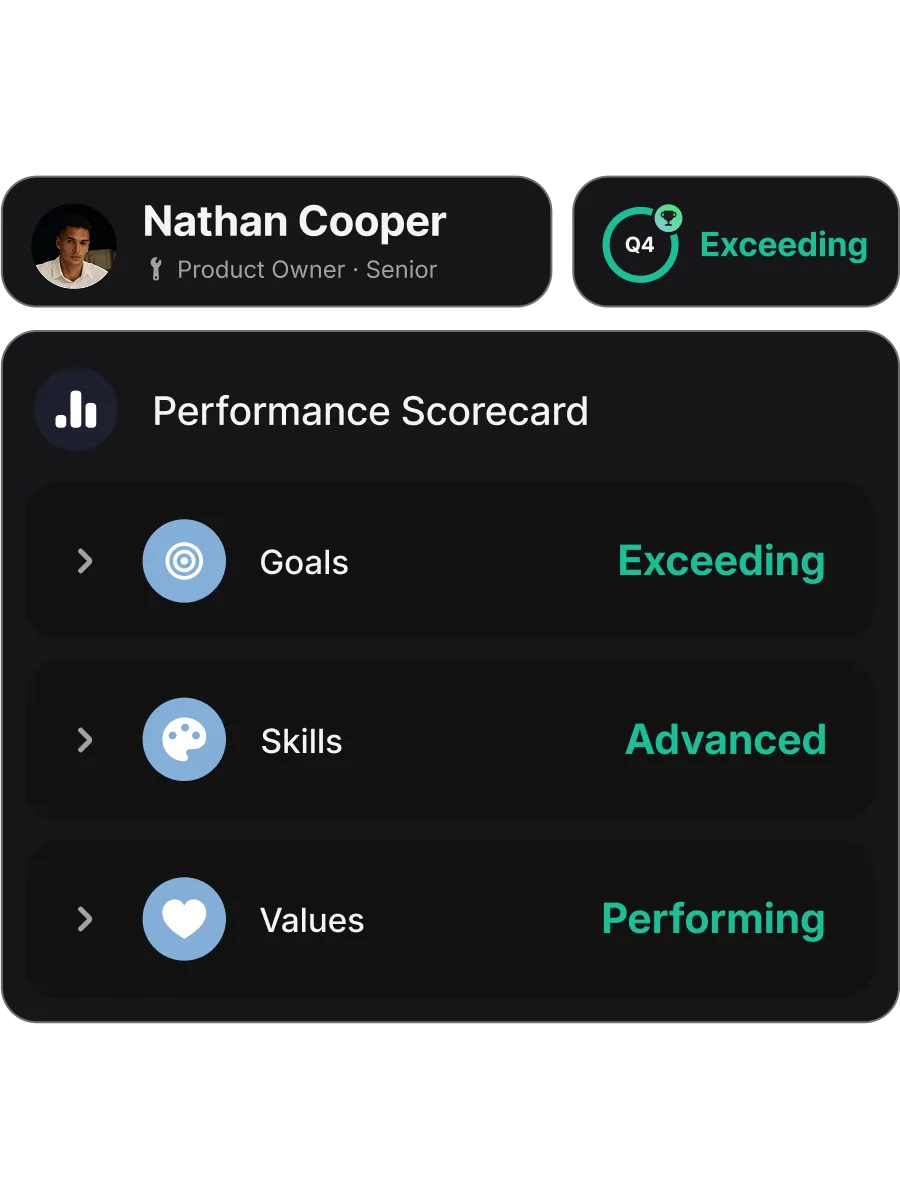
Revolut People runs goals, reviews and calibration on scorecards for goals, skills and values. Here is what its public documentation shows, mapped to the calibration test:
- Three calibration modes. Admin, Manual and Structured, where Structured mode supports multi-stage, rule-based calibration with up to five stages (calibration overview, calibration methods, structured mode).
- System-generated calibration flags such as Line Manager Leniency, “Grade not supported by deliverables”, “Grade not supported by bar raiser questions” and Historical Performance Decline, comparing the current cycle with the last four (calibration flags).
- Recommended grades, including a Ranking Grade option that ranks employees on a composite score and maps them to a predefined grade distribution (Ranking Grade).
- Sign-off by Heads of Department and Heads of Function, with the option to add a justification when a grade is changed (calibrating as Head of Department, as Head of Function).
- Evidence in the review: self, peer and upward reviews, a review scorecard, bar raiser and custom questions, and AI help with feedback that managers review before submitting.
- Goals that cascade (cascading goals) and goal integrations including Jira, Salesforce, HubSpot and Looker, and HR platform integrations for BambooHR, HiBob, Personio and Workday. Check your own stack with the stack-fit checker.
One customer result, as the Playbook’s Ebury customer story states it: departmental calibration time cut from 4 hours to 1 hour, a 75% reduction. For pricing, use the pricing estimator rather than a number on this page.
When it isn’t the right fit: if your main purchase is an engagement survey programme with external benchmarks, start with the tools that lead with that; this page doesn’t assess Revolut People’s survey features. If you want a light check-in tool and don’t plan to calibrate grades, structured calibration is more than you need. If your leaders want calibration with no system input, recommendations can be set to “No Recommendation” (overview), but check whether flags would help or get in the way. To see the product first, take the 2-minute product tour.
How to run your shortlist
Use the buyer’s guide’s two-job-family pilot:
- Pick two job families, for example one engineering and one commercial.
- Write their scorecards and grade scale before any vendor call.
- Ask each vendor to set them up and run the calibration walkthrough test.
- Fill in the dated scorecard straight after each call.
- Compare total annual cost: minimum spend, add-ons and implementation fees, not just per-seat price.
If you are moving from spreadsheets, the guide to switching from spreadsheets to performance management software covers what to move first. For a second opinion on your shortlist, book a 15-minute review with Ash, Product Sales Executive at Revolut People.
FAQs
Which is better for performance reviews: Lattice, Culture Amp or 15Five?
It depends on what you are buying for. Lattice’s Performance product lists reviews, calibration, promotions and PIPs at a published per-seat price. Culture Amp leads with engagement surveys and sells on quote. 15Five is built around manager check-ins and 1-on-1s, with Perform priced per user. For a 200 to 2,000 person scale-up, test each one on a single job before price: can it run a calibration meeting with evidence and flags, not just a ratings grid?
How much do Lattice, Culture Amp and 15Five cost?
As published on each vendor’s pricing page on 10 November 2026: Lattice Performance is $10 per seat per month with a $4,000 minimum annual agreement. 15Five Perform is $11 per user per month, billed annually. Culture Amp doesn’t publish a list price and quotes by headcount, product and service tier. Check the pages again before you budget, because prices change. For a side-by-side of published prices, including vendors who quote only, see how much performance management software costs.
Which handles calibration best?
All three list calibration on their own pages: Lattice in Performance, Culture Amp as built-in calibrations with reports, and 15Five with real-time calibration, discussion flags and track changes. None of those pages shows how it works on your data, so run the calibration walkthrough test with each vendor.
What should I ask each vendor to show me in a walkthrough?
Ask them to show, live, how the tool spots a generous grader, a grade with thin evidence and a sudden jump since last cycle. Then ask who can change a grade and where the reason is recorded, how grades are published, and whether it runs on your own grade scale.